Thursday, February 28, 2008
Statement of Process
This project was great. I had no trouble finding info until I came to citing the bibliography because it's not my best thing right now. That was my only problem during my blog posts. I had a smooth time posting each question down. After I posted my answers to my questions, I added some pictures on my blog.

Reflection
The Revolutionary War Blog project was a successful project. I had fun learning about Molly Pitcher and her brave acts that led her to be known in the U.S. I had some hard time gathering information but then I got help from my fellow friends in 702 and 731. I learned that she risked her life to fire the cannons and help soldiers during the hot, sunny war. She should have been awarded and she was for her kind and generous act to help her country win this devastating and long war.
Bibliography
Internet Sources
BRAVO, Battlefield Restoration and Archaeological Volunteer Organization. "Molly Pitcher". New Jersey Division of Parks and Forestry, State Park Service. http://bravo_nj.tripod.com/id15.html
"Molly Pitcher". Wikipedia (OR Wikimedia Foundation)
January 24, 2003
www.en.wikipedia.org/wiki/Molly_Pitcher
Book Sources
Alder, David. Heroes of the Revolution. Holiday House; 2003
Burke, Rick. Molly Pitcher. Heinemann Library; 2003
Stewart, Gail. The American Revolution. Blackbirch Press; 2004
BRAVO, Battlefield Restoration and Archaeological Volunteer Organization. "Molly Pitcher". New Jersey Division of Parks and Forestry, State Park Service. http://bravo_nj.tripod.com/id15.html
"Molly Pitcher". Wikipedia (OR Wikimedia Foundation)
January 24, 2003
Book Sources
Alder, David. Heroes of the Revolution. Holiday House; 2003
Burke, Rick. Molly Pitcher. Heinemann Library; 2003
Stewart, Gail. The American Revolution. Blackbirch Press; 2004
Would I be friends with her?

I would be friends with Molly Pitcher because she did such a brave and great act for her country and even though she was a woman she was able to be successful. She would've helped fight other wars and be greatly honored and known. She could help the soldiers today cope with their loss of a part of their body or injuries by nursing them. I would be friends with her because I wanted to know how she felt during the war and what happened. She could be a role model for all the girls who don't think that war should be there thing.
10 Vocabulary Words
Vocabulary Words
- regiment-a military unit consisting usually of a number of battalions
- domestic-of or relating to the household or the family
- veteran-an old soldier of long service
- commission-a formal written warrant granting the power to perform various acts or duties
- barrack-a building or set of buildings used especially for lodging soldiers in *garrison*
- ration-a food allowance for one day
- commemorating-to mark by some ceremony or observation
- valiant-feeling or displaying no fear by temperament
- triumph-a successful result brought about by hard work
What did I do for a living?
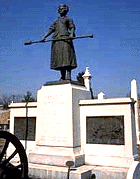
For a living, I was a farm girl when I was very young. Then after I married John Hays, he was enlisted in Colonel Thomas Procter’s First Pennsylvania regiment artillery. So I followed my husband into war. From that time on, I nursed the sick and I assisted in cooking and washing. So basically I was a hospitality helper.
Wednesday, February 27, 2008
Telling you where I came from and how did I live?
My real name is Mary Ludwig and I'm the daugther of a German settler, John George Ludwig. I grew up and helped my father, who was a dairyman, on the farm. I was raised to be a hard worker, so I was a heavy-set, strong, and sturdy girl. I could do all the chores and tasks that a small farm would need.Then in 1768, I was hired by Mrs. Irvine from Carlisle, Pennsylvania, because she wanted a young girl to help with the housework.I had to live with a doctor and Mrs. Irvine for few years, and then I met my husband, John Casper Hay, a local barber. We married on July 24, 1769. I was so happy to have a husband, so charming.
If I had opposition, who were the my foes?
My foes weren't much of a problem because it was everybody's problem. I wasn't the only one to hate them, almost all of the Americans hated them. My enemies were the British Army and Britain.
What are five notable facts about her?
- She nursed the wounded soldiers.
- She was also known for carrying a wounded soldier off the battlefield.
- She fought at the Battle of Monmouth.
- She was awarded forty dollars for her brave act during the war in 1822.
- On the Fourth of July, the citizens honored her during the 100th aniversary of the Declaration of Independence.
Tuesday, February 5, 2008
How did she meet her death?
She met her death at January 22, 1832, in Carlisle, Pennslyvania, U.S. She died because of skin cancer.
Wednesday, January 30, 2008
What is she "famous" for?
I am famous for swabbing the cannons because as I said before my poor , tired husband fell from heat stroke. People call me either Sargeant Molly, or the Brave Soldier because of my brave act. I am proud of saving the Continential Army from losing the Battle of Monmouth.
Tuesday, January 29, 2008
What role did Molly Pitcher play in the building of our nation?

At the Revolutionary War, I carried cold water to the hot and tired soldiers. Then my husband was assigned to fire the cannon but all of a sudden, my husband fainted because of heat stroke. So I took his position and started firing the cannon.
Who is your person and when and where was Molly Pitcher born??
Hi! My name is Ludwig Hays McCauley and I was named Molly Pitcher for bringing pitchers of water to the thirsty soldiers. I was born on a small farm near Trenton, New Jersey on October 13, 1754. My brothers' names are Joshua, Joseph, and Carl. My mother's name is Gretchen and my father's name is John. I was married to John Hays and I wanted to serve the army because I couldn't send my husband alone into war, so I joined him.
Subscribe to:
Comments (Atom)
